Sunday, 6 May 2012

THE POLITICAL PARAPHERNALIA SURROUNDING TAGORE


“And into that heaven of freedom, my Father, let my country awake...”

Rabindranath Tagore. A name associated with mysticism and romantic poetry. A name that no Indian can fail to recognize. And a name, which increasingly began to give voice to the minds of the colonized and oppressed, and expressed a passionate desire to be identified as one of them, after failing in his quest to blend the spiritual and romantic notions of an individual’s soul with the divine.
Rabindranath Tagore had multitudinous facets to his personality and one of those was his fierce criticism of Nationalism. His antipathy to the conventional idea of a Nation was legendary. He felt that nationalism was not a spontaneous self-expression of man as a social being but a great menace which was “supremely dangerous to humanity”. It was a “terrible absurdity” which had rapaciously thriven long upon mutilated humanity.

He denounced Nationalism, condemning it to be self-idolatry and criticized it to be a neatly compressed bale of the dregs of humanity, bound in iron hoops, and labeled with scientific precision. This marked animosity of his with the ideal of a Nation was immortalized when he warned the masses that they, who were living under a delusion that they were free, were actually sacrificing their freedom and humanity to the fetich of nationalism and living in a dense, noxious atmosphere of worldwide suspicion, greed and panic. He astringently accused nations for fixing their fangs deep into the naked flesh of the world and systematically petrifying its moral nature in order to lay a concrete foundation for its gigantic abstractions of efficiency. But in spite of all these scathing comments, he was essentially a humanitarian who has faith that man would have his new birth, in the freedom of his individuality, from the shrouded vagueness of abstraction.

Tagore was a political dissenter in India who was against Mahatma Gandhi’s ‘Cult of the Charkha’. He felt that the Swadeshi Movement was predominantly led by the wealthy, orthodox and reactionary Hindus with little or no connection to the lower strata of society, especially the Muslims. He has superbly articulated the darker strains of political intrigue that were the undercurrent to this movement in his 1915 novel ‘Ghare Baire’. His experiences in the Swadeshi Movement indisputably played a critical role in his antagonism to Nationalism in its radical avatar.

Tagore always emphasized on the loftier ideals of humanity instead of acclimatizing to the patriotic rhetoric of his times. He believed that every manifestation of patriotism becomes the magnification of the self on a stupendous scale – it magnifies our vulgarity, cruelty and annihilates every notion of humanity. He violently protested against the ruthless lust of arrogant, imperialistic power-seeking individuals, who were suppressing the voice of the people in order to gain supremacy.

Tagore was a man who eloquently expressed the unspoken desires of the Indian consciousness at that time. Through his relentless tirade against the tralatitious political, cultural and social superstitions, he peeved many of his detractors. He was criticized for being an apostate and his ideals were perceived as being up in the air. He was reduced to being a figure of merely parochial significance and was assumed to remain only a hagiographical legend in Bengal.

Rabindranath Tagore has left a colossal legacy behind, political included. His alternative, out-of-the-box vision has become more appropriate in the modern world, filled to the brim, as it is, with fanaticism and zealotry. It is time we gave it the importance it deserves.

Friday, 4 May 2012

MIND YOUR LANGUAGE!


The last speaker of Bo, an ancient language in India in the Andaman Islands, which has now been amalgamated with ten other major languages of the Andaman Islands and is now referred to as the Great Andamanese, died in a bleak hospital in Port Blair; the Cochin Creole Portuguese language died with the demise of William Rozario in Vypeen, Kerala; and Eyak, a language spoken in the Gulf of Alaska vanished in 2008 when its last speaker, Marie Smith Jones died at the ripe old age of 89. It’s official: vernacular languages are being exterminated at an alarming pace where it is more than likely that by 2100, more than half of the 7,000 languages spoken on Earth will have died out. This rate of extinction of languages by far exceeds even that of animal species.

WILLIAM ROZARIO
BOA SENIOR


When Boa Senior, 85, the last speaker of Bo died, nearly 55,000 years of thoughts and feelings and ideas- the collective history of an entire tribe- died along with her. The Cochin Creole Portuguese was widely regarded as a bastardized version of ‘real’ languages but that does not eclipse the fact that it was still spoken by a large community in India and does not exist anymore.

Nowadays, the wiping out of colloquial histories of tribes has become a common garden event. Eviction of tenants from their lands, battles, genocide, illness, urbanization, globalization, you name it. The reasons are wide ranging and innumerable. As children are taken away from their communities and ruthlessly forced into education systems that slowly strip away traditional wisdom and replace them with new-fangled ideas of the world, so the world’s tribal languages are crumbling into decay. And with the death of tribes and the extinction of their languages, unique parts of human society that once flourished, become nothing more than memories to be cherished and venerated.
It is of vital importance to preserve these languages because saving them is much the same as saving humanity. Your language is your culture and your culture is your identity. In the cosmic scheme of things, people aren’t worth a penny. Among the teeming masses, your death and the death of people close to you will seem like nothing. Your only legacy would be the continuance of a language you speak. It will live on. But if that very language is tottering on the edge of extinction, then your entire cultural history with be worth for naught!

There are a lot of challenges that vernacular languages face and globalization, first and foremost, is one of them. Although the world is now better connected than ever and we are communicating in ways that we couldn’t even have imagined a century ago, it also poses a major threat to ancient languages in the world.

The language most commonly associated with globalization, often disparagingly, is English. The spread of this language alarms many who view it as a ‘killer’ language that is one which displaces the use of a nation’s mother tongue as it spreads.

Take case in point: In India, after independence, the British left us more than architectural marvels and bitter memories; they left us a language. A language which has rapidly undermined other Indian languages in its favour. It has been estimated than nearly 9% of Indians now speak English as their first language, which includes you and me. This number is second to only Hindi, our national language. For us, English has become the modern lingua franca, a language with which we associate ourselves because it is fashionable to do so and speaking English seems a very sophisticated and elegant practice. How did this happen? How did a dialect, spoken by a backward, semi-literate tribe in the south-eastern corner of a small island in the North Sea spread, like some malignant pandemic virus, across the globe? Should we feel guilty that our way of speaking is obliterating so many other native tongues? Is it not a more sinister kind of colonialism than that which the British practiced in our country some 60 years ago? English is overtaking every other language in the rat race to become prima donna in the Linguistic Premier League. Chances are that for a few generations most humans will be speaking English. But don't despair and don't exult. The Romans fondly believed it would be Latin.

Thus, what we are witnessing in the 21st century is linguicide. The complete and total annihilation of vernacular languages. In the 20th century, power came from behind the barrel of a gun. Now it also comes from the Oxford English Dictionary.

Shoe.

NOT-SO-DESPICABLE ME


They are the shadows in the dark, the blood on the walls; Mephistophelian, they roam the darkness, extinguishing all that is pure, seeping into the lives of innocent men and women, like a noxious gas that brings no good. They plot schemes that bring about the downfall of all those who have sworn to protect; they hatch plans that inter the already dying ideals of faith and humanity. They are… Now wait just a minute. Where are the super villains I was just describing? What happened to fictitious characters like The Joker, arch-nemesis of the Batman, with his warped view of the world, sadistic sense of humour, a schizophrenic clown with that hideous smile carved on his face that says “why so serious?”? What happened to Dr. Doom, the genius inventor, sorcerer, pure evil personified, enemy of The Fantastic Four? What happened to Lex Luthor, Dr. Octopus, Darth Vader, Jabba the Hutt, Harley Quinn, Poison Ivy, Venom and Bane?

An incompetent villain is like incidental music with too much pizzicato violin plonking. A mediocre villain makes your hero, and all the other characters, look proportionately less impressive as well. And there's nothing more unimpressive than a villain who's got a mental block against disposing of his or her nemesis.
So let’s see the top 5 not-badass-at-all villains that have been left at our door, for us to endure.


 #5. Heinz Doofenshmirtz 


He is a 47 year-old mad scientist appearing on the popular TV show Phineas and Ferb. He is the head of Doofenshmirtz Evil Inc., but there is nothing evil about this character. Admittedly he attempts to wreck havoc on “the entire Tri-State Area and then the world!” but always ends up being beaten by Perry the Platypus. He is so used to being foiled that he tends to be upset on the few occasions when Perry does not stand in his way. The only thing impressive about him is his purchased doctorate off the internet under the pseudonym StrudelCutie4427.


#4. Rainbow Raider


With a name like Roy G. Bivolo, (ROYGBIV, a mnemonic for the colours of the rainbow), everyone thought he was destined to be an artist. There was a teensy problem though. He was colourblind. He thought he painted beautiful pictures only to be told they were made up of clashing colours due to his itty bitty problem. His father, saddened by this, made him a sophisticated pair of goggles that would allow Roy to create beams of solid rainbow-colored light. But Roy, tired of the unappreciative world, turned these goggles to sinister use, taking the name of Rainbow Raider as he has the insidious power to affect people’s emotions by coating them in a specific color. How very ingenious and diabolical. I’m sorry, this is as scary as a leprechaun putting on a pair of bull’s horns and charging at you. 

Seriously, Rainbow the Clown, from The Power Puff Girls, is scarier.


#3. The Team Rocket Trio


At first sight, you’d think they were the perfect villainous trio, what with their epic motto and credentials. But as the Pokémon series progress, all you can feel is frustrated. If you really want Ash Ketchum’s Pikachu that much, then hatch a better plan and TAKE HIM! The trio consists of Jessie, the aggressive one, James, the effeminate one, and Meowth, the one who hatches all the plans to please their boss Giovanni, who considers the trio to be incompetent. As they are.

Team Rocket blasts off again?


#2. Kite Man


The idea of a Kite Man was flawed from the start, because choosing such an unwieldy method of transport left him open to freak gusts of wind. If that wasn't enough, the colour of his costume was pink. Baby pink, to be precise. Decidedly emasculating for a villain. And if that wasn't enough, his method of attack was to throw kites at people. That didn't even hurt in kindergarten. Utterly useless, he met his end by falling off a tower (without his kite obviously), somehow surviving, but then being eaten in jail in Gotham City by Bruno Mannheim. It served him right. He was such a wuss, he didn’t even join the Secret Society of Super Villains in Gotham City. Perhaps, the only redeeming quality of this character is that he was named after Charlie Brown, the main character in Peanuts who has a notable fondness for flying kites.

And for the crowning glory...


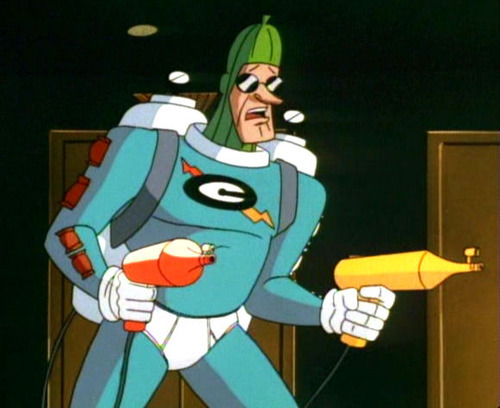
#1. Condiment King


You might as well call him the Mustardy Ketchup Man. He makes use of various condiments, notably ketchup and mustard, to foil his enemy, Batman, but is almost never taken seriously, because of the ludicrous nature of his ‘powers’. His only real danger comes from the possibility of causing anaphylactic shock in his victim, who would have to a) exceedingly unlucky to be hit by a nut-based product and b) have forgotten to bring his EpiPen while out on a jaunt. Useful only for his potential as a punning device: frequently guilty of as-salt, you can't ketchup with him...even despite the fact that he just doesn't cut the mustard for us.

So here they were. Villains who don’t scare you in the least or put the fear of God in you. Shame on them. I shall, as always, end with a Parthian shot.

‘Bane could see it. Batman, pale, blinded by light, smeared with filth, dressed in tatters, so thin his ribs almost burst from his skin, his arms and legs flopping, drool leaking down his chin. And then he said, “Put fire to his feet. I want to hear him scream.”

That, my friends, is all what a super villain has to be. Diabolical, full of hatred, vindictive to the core, filling the dregs of humanity with a hatred so powerful it could make The Joker seem like a cheap trickster.
-Shoe.